
LVR CPR Training Brisbane – Sandgate
Need LVR CPR training for work, site access, an expired certificate, or an employer deadline? Deep Breath Institute delivers low voltage rescue and CPR training in Sandgate, Brisbane.
Workplace group bookings are also available across Queensland.
This course includes two units:
UETDRMP018 – Perform rescue from a live low voltage panel
HLTAID009 – Provide cardiopulmonary resuscitation
Training and assessment are delivered on behalf of Allens Training Pty Ltd RTO 90909. Students receive nationally recognised training after they pass all required tasks.
The course is for workers who need current CPR LVR records. This includes electricians, apprentices, contractors, safety observers, solar workers, maintenance teams, and facilities staff.
It covers live low voltage panel rescue, rescue equipment, CPR, AED use, and emergency response in electrical work.
This is not a full first aid course. It includes CPR training, but it is not the same as a first aid certificate. It also does not cover overhead lines, underground cables, high-voltage rescue, confined space rescue, or specialist rail work.
Units Delivered
The following units will be included in your certificate:
- HLTAID009 – Provide cardiopulmonary resuscitation
- UETDRMP018 – Perform rescue from a live low voltage panel
Course Delivery
This course can be delivered/assessed in the workplace or at facility organised by the training provider.
Course Durations
Course durations can vary for multiple reasons, so the durations below are the minimum possible amount.
- Refresher face-to-face contact time of at least 3 Hours 30 Mins
- Face-to-Face face-to-face contact time of at least 5 Hours
- Online with face-to-face assessment face-to-face contact time of at least 1 Hour
Entry Requirements
An individual undertaking this course with Allens Training Pty Ltd will need to demonstrate the following to be eligible for entry:
- An official form of photo identification, for example driver’s licence, passport, or student ID.
- Physical capability to be able to meet the demands of the practical demonstration skills including CPR.
To successfully complete this course, students will need to demonstrate the following language, literacy, numeracy and digital (LLND) skills during training and assessment:
- Learning: follow safety steps in order, remember what to do in an emergency, and learn by practising.
- Reading: read and understand emergency signs, safety labels, and rescue instructions related to electrical dangers.
- Writing: fill in simple forms or record what happened during an emergency or training.
- Oral communication: speak clearly and listen carefully when giving or receiving information during an emergency situation.
- Numeracy: read numbers, like voltage or time, and understand basic timing and measurements.
- Digital Literacy: use a mobile phone or basic device to read messages, follow online instructions, complete online forms or access learning resources.
Important note: In order to issue an accredited certificate, CPR must be performed on the floor with no exemptions.
Online learning: Students must have basic digital literacy skills to navigate online platforms, complete assessments, and access course materials. Before enrolment, students should assess their ability to engage in online learning. Support is available where required.
The online learning program can be found in the student portal. Students must have access to a computer, smart phone, tablet or other electronic device with access to the internet to complete the online studies and associated assessment tasks.
Delivery mode: Online with face-to-face. The online pre-course learning and theory assessment is expected to take approximately 3-4 hours to complete. These timeframes are estimates. Individuals with prior experience in similar training may complete the online component in less time, while those new to the subject may need more time to complete all the learning content and theory questions.
Assessment Requirements
Individuals undertaking this course will be expected to complete both written and practical assessment tasks.
Certificate Renewal Requirements
The units have the following recommended renewal periods:
- HLTAID009 – Provide cardiopulmonary resuscitation: 12 months
- UETDRMP018 – Perform rescue from a live low voltage panel: 12 months
Learner Rights, Responsibilities & Support
Please note that enrolment to this course is made with Allens Training Pty Ltd RTO 90909. Please refer to the student handbook located on the RTO website allenstraining.com.au for all details relating to rights and responsibilities including complaints and appeals.
Assessment Activities
Performance tasks and Practical scenarios:
- Performance Task – Adult CPR
- Performance Tasks – Infant CPR
- Performance Task – Inspect and position LVR Kit and equipment
- Simulated Scenario – Perform a rescue from a live LV panel
Theory assessment – A written assessment consisting of multiple-choice questions.
Core Skill Requirements
Students are required to complete a self evaluation against the following core skills as part of the enrolment process. This will allow your trainer to understand any additional support that may be required during the course delivery and assessment.
- Learning: I can follow safety steps in order, remember what to do in an emergency, and learn by practising.
- Reading: I can read and understand emergency signs, safety labels, and rescue instructions related to electrical dangers.
- Writing: I can fill in simple forms or record what happened during an emergency or training.
- Oral Communication: I can speak clearly and listen carefully when giving or receiving information during an emergency situation.
- Numeracy: I can read numbers, like voltage or time, and understand basic timing and measurements.
This course is delivered and assessed on behalf of Allens Training Pty Ltd RTO 90909.
Check Before You Book
This course may suit you if your employer or site has asked for:
- UETDRMP018 – Perform rescue from a live low voltage panel + HLTAID009 – Provide cardiopulmonary resuscitation
- LVR CPR
- CPR LVR
- low voltage rescue and CPR
- rescue from a live LV panel with CPR
- rescue from live electrical apparatus
- safety observer rescue and resuscitation training
Before booking, check:
- your required unit codes
- whether you need CPR only or full first aid and CPR
Deep Breath Institute can help you choose the right course And map trailor your training to met Your employer, site, or contractor requirements..
Course Snapshot
|
Detail |
Information |
|
Course |
LVR CPR Training |
|
Units |
UETDRMP018 + HLTAID009 |
|
Price |
From $110 per person |
|
Location |
Sandgate, Brisbane |
|
Course options |
Face to face, refresher, online learning with face-to-face assessment, and workplace training |
|
Best for |
Electricians, apprentices, safety observers, solar workers, contractors, and maintenance teams |
|
Outcome |
Nationally recognised training after passing all required tasks |
|
Renewal |
Many workplaces expect CPR and LVR refreshers every 12 months |
|
Group bookings |
Available for Brisbane and Queensland workplaces |
Book your Sandgate course online, or contact Deep Breath Institute for workplace training.
This Course Does Not Cover
This course is not for every electrical rescue need.
It does not cover:
- high-voltage rescue
- overhead line rescue
- underground cable rescue
- confined space rescue
- specialist rail training
- employer-specific electrical supply industry units
- site induction or permit training
If your employer gave you exact wording, compare it with the unit codes on this page.
Is This Course Right for You?
Course names can vary between employers. Unit codes matter because many site systems, portals, and workplace records check them.
A Brisbane apprentice or contractor may be blocked from a site. This can happen when a record is missing, expired, or listed under an old unit code.
Before you pay for another course, check what the site needs. It may need LVR, CPR, LVR CPR, first aid, or proof of prior training.
LVR Only, LVR CPR, or First Aid?
Not every worker needs the same training. Some need CPR only. Some need low voltage rescue and CPR together. Others need a full first aid certificate as well.
|
Situation |
Course type to check |
Common wording |
|
Employer says “CPR only” |
HLTAID009 |
CPR refresher, annual CPR |
|
Employer says “LVR CPR” |
UETDRMP018 + HLTAID009 |
CPR LVR, LVR CPR, LV rescue and CPR |
|
Employer says “first aid certificate” |
HLTAID011, if required |
First aid, workplace first aid |
|
Working near live low voltage panels |
UETDRMP018 + HLTAID009 |
Rescue from a live LV panel |
|
Working with overhead or underground assets |
Separate training may be required |
Overhead lines, underground cables |
|
Site induction plus rescue training |
Check site rules |
Contractor portal requirement |
If your CPR is current but your LVR has expired, check with your employer. Their rules may require LVR only, LVR CPR, or a full course set.
Current Units
Deep Breath Institute’s course set includes two nationally recognised units.
UETDRMP018 – Perform Rescue From a Live Low Voltage Panel
UETDRMP018 teaches workers how to rescue someone from live low voltage electrical equipment.
It covers rescue from live low voltage electrical apparatus in an electrical work setting. The official unit does not include overhead lines or underground cables.
HLTAID009 – Provide Cardiopulmonary Resuscitation
HLTAID009 covers CPR and AED use.
It also covers how to assess an emergency situation, stay safe, protect bystanders, and call emergency services.
Students must perform CPR in line with Australian Resuscitation Council guidelines.
Older LVR Unit Names
Some workers still see old wording in employer emails, portals, or past certificates.
Do not assume your site will accept an old code.
|
Older wording you may see |
What to check now |
|
UETTDRRF004 |
Ask whether UETDRMP018 is now required |
|
UETTDRRF06B |
Check the current site rule |
|
“LVR” only |
Confirm whether CPR is also required |
|
“CPR LVR” |
Confirm whether the units are UETDRMP018 + HLTAID009 |
|
“LV rescue” |
Ask whether CPR is included |
|
“Electrical rescue” |
Check whether this means low voltage rescue, high voltage, rail, ESI, or another rule |
If your site rejects your certificate, ask why. The issue may be the unit code, expiry date, CPR status, missing proof, RTO arrangement, or wrong course type.
Need Site Access Fast?
Many workers need LVR CPR training fast. Their certificate may have expired. Their site record may be missing. Their employer may need proof before the next shift.
To reduce delays:
- check the required unit codes
- book the correct course
- complete any online pre-course learning
- bring photo ID
- bring proof of prior training if requested
- attend the face-to-face practical session
- pass the theory and practical tasks
Deep Breath Institute avoids risky “instant certificate” promises. You receive nationally recognised certification once all theory and practical elemenst ahave been successfully completed.
What Happens After Booking?
After booking, check your confirmation details.
It will tell you what to complete before class. It will also list where to go, what to bring, and whether online learning applies.
Before your session:
- complete all learning content if online learning is required
- check the Sandgate venue details
- check your arrival time
- bring photo ID
- wear enclosed footwear
- wear suitable clothing
- bring any requested evidence
- contact Deep Breath Institute if you are unsure about course needs
If you arrive without finishing the online learning, your assessment may be delayed.
Course Options and Duration
Deep Breath Institute offers several course options. The right option depends on the course format and your eligibility.
|
Course option |
Best for |
Time needed |
|
Face to face |
First-time students or people who prefer in-person practical training |
At least 5 hours |
|
Refresher |
Returning students who meet refresher rules |
At least 3 hours 30 minutes |
|
Online learning with face-to-face assessment |
Students completing theory before practical assessment |
At least 1 hour face to face, plus online learning |
|
Workplace group training |
Employers booking several staff |
Confirm with Deep Breath Institute |
The online part may take about 3–4 hours.
Refresher options may only suit eligible students. Check your booking details before you enrol.
What Training Covers
This course is practical training for electrical emergencies. You practise rescue steps, CPR, and emergency response in a mock setting.
Low Voltage Rescue Skills
Training covers:
- scene safety
- electrical hazards
- risk management
- safe approach to a casualty
- rescue from a live LV panel
- checking rescue equipment
- using an LVR kit
- isolation where safe
- moving a casualty away from danger
- recovery position
- talking with emergency services
The goal is to help workers respond without rushing into danger.
CPR and AED Skills
The CPR component covers:
- recognising an emergency situation
- checking response and breathing
- calling or directing 000
- performing cardiopulmonary resuscitation
- using an automated external defibrillator
- following Australian Resuscitation Council guidance
- caring for the person until professional medical help arrives
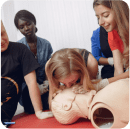
Students must perform CPR during the assessment, which is conducted on an adult CPR on a manikin placed on the floor.
Rescue Equipment and Safety Practices
You may use or discuss:
- rescue crook or rescue hook
- insulated gloves
- fire blanket
- CPR mask
- AED trainer
- safety signage
- low voltage rescue kit
- personal protective equipment
Rescue equipment matters because electrical emergencies are rarely tidy. The power may still be live. A casualty may still be in contact with equipment. Bystanders may panic.
Good LVR training teaches the safest order of action.
Emergency Response Steps
A safer low voltage rescue response follows this order:
Assess the scene → isolate power where safe → use rescue equipment → move the casualty → check breathing → call 000 → start CPR and AED use if needed → hand over to emergency services → report the incident → check or replace used equipment.
This order supports workplace safety and helps workers think clearly under pressure.
Common Booking Issues
Many students book LVR CPR to update a site record. Others need to renew an expired certificate or meet an employer deadline.
These are common issues to check before you enrol.
Booking CPR Only
If your employer asks for both UETDRMP018 and HLTAID009, CPR alone is not enough.
Check both unit codes before you book.
Missing Online Learning
Some courses include online training before the practical session.
Complete the online pre-course learning before you attend.
Using an Old Certificate
Old certificates may show old LVR unit names.
If your site asks for current LVR CPR training, confirm whether it requires UETDRMP018.
Confusing CPR With First Aid
HLTAID009 is CPR. It is not the same as HLTAID011 Provide First Aid.
If your employer asks for a first aid certificate, check whether you need first aid as well.
Missing Physical Requirements
CPR assessment includes practical skills.
Students must perform adult CPR on a manikin placed on the floor.
Assessment
Students must complete theory and practical tasks.
The written task may include questions about:
- low voltage rescue
- CPR
- risk
- safety rules
- rescue equipment
- AED use
- emergency response
The practical LVR task includes a mock rescue from a live low voltage panel.
You may need to:
- check the LVR kit
- spot hazards
- place rescue equipment
- move a casualty safely
Students must show CPR on a manikin. Students may also need to show infant CPR and AED use.
Attendance alone does not guarantee a certificate. Students must complete all required tasks.
If the trainer marks you as not yet competent, they will explain the next steps. These steps follow the course assessment and reassessment process.
Physical and Learning Requirements
This course requires practical skills, communication, and suitable fitness.
Students need to be able to:
- kneel on the floor
- perform CPR compressions
- move through a mock rescue task
- use rescue equipment
- read safety information
- follow trainer instructions
- complete written tasks
- communicate during practical tasks
Students need a standard of English, reading, maths, digital, and visual skills. to effectively read signs, follow instructions, complete online learning, and respond during practical tasks.
If you have an injury, health concern, mobility limit, or support need, contact Deep Breath Institute before booking.
You must complete the required practical tasks to receive a certificate.
What to Bring
Bring:
- photo ID
- USI details if required
- enclosed footwear
- suitable clothing
- water bottle
- lunch or snacks if needed
- device and internet access for online learning
- completed online pre-course learning, if required
- proof of prior training if requested
- PPE if your booking details list it
Check your booking confirmation for access, arrival time, parking, and public transport details.
LVR CPR Training in Sandgate
Deep Breath Institute delivers public training from:
Shop 3 / 80 Loudon Street, Sandgate QLD 4017
Students can train at the Sandgate site. The team can also deliver courses at workplaces or other venues where suitable.
The Sandgate location suits Brisbane northside workers. It is close to Brighton, Deagon, Shorncliffe, Bracken Ridge, Boondall, Virginia, Geebung, Northgate, Nundah, Chermside, North Lakes, and Redcliffe.
Brisbane electrical workers support many sites. These include commercial buildings, construction projects, hospitals, universities, logistics zones, industrial sites, property maintenance, public infrastructure, and energy work.
For many of these roles, current LVR CPR training helps workers stay compliant and ready for work.
For employers, Brisbane’s spread of worksites matters. A crew may be split between a northside job, an airport-area maintenance contract, and a southside industrial site.
Group training can help bring workers onto the same renewal cycle instead of booking one person at a time.
Workplace and Group Bookings
Deep Breath Institute offers workplace training and group bookings where suitable.
Group LVR CPR training may suit:
- electrical contractors
- maintenance teams
- solar companies
- facilities management businesses
- construction employers
- industrial sites
- logistics and warehouse operators
- health and education facility teams
- employers managing annual refreshers
Workplace training can reduce travel. It can also keep staff on one renewal cycle and support compliance planning across Queensland.
Employer Booking Checklist
Before booking several workers, prepare:
- staff names
- current CPR issue dates
- current LVR issue dates
- unit codes on existing certificates
- any site-specific wording
- preferred training window
- workplace address, for onsite training
- training room or clear practical space
- access, PPE, or induction rules for the trainer
- invoice or purchase order needs
- known physical, language, or learning support needs
This helps Deep Breath Institute guide your booking and reduce admin delays.
How Often Should You Renew?
Many workplaces require CPR and LVR refreshers every 12 months. Rules can vary by employer, site, contractor portal, or industry.
Allens Training recommends renewal every 12 months for both HLTAID009 and UETDRMP018.
Check your:
- employer requirement
- site induction requirement
- contractor portal
- licence or trade requirement
- certificate issue date
- CPR current status
- LVR current status
Book before your certificate expires to avoid unnecessary work delays.
Why Choose Deep Breath Institute?
Deep Breath Institute delivers practical first aid, CPR, and workplace emergency response training from Sandgate.
Tom Hassall founded Deep Breath Institute. He is a registered paramedic and lead instructor. He started DBI because many first aid and CPR courses focus on ticking boxes, not building confidence.
That matters for LVR CPR because a real electrical emergency is not a neat classroom script.
Students need to practise the steps, understand the order, and know when not to rush in.
Deep Breath Institute’s training team includes educators who work in the field, such as paramedics and frontline health workers.
Workers can attend public courses in Sandgate. Employers can also ask about workplace training for teams across Queensland.
Training and assessment are delivered on behalf of Allens Training Pty Ltd RTO 90909.
Students receive nationally recognised training after passing the required tasks.
Training Standards and Sources
This course includes nationally recognised units:
UETDRMP018 – Perform rescue from a live low voltage panel
HLTAID009 – Provide cardiopulmonary resuscitation
Students should check official unit information, employer instructions, and site requirements before booking.
The national register says UETDRMP018 covers rescue from live low voltage electrical equipment. It excludes overhead lines and underground cables.
HLTAID009 requires students to perform CPR in line with ARC guidelines. It also includes AED use based on the maker’s instructions.
Training and assessment are delivered on behalf of Allens Training Pty Ltd RTO 90909.
Last reviewed: June 2026
Training delivered on behalf of: Allens Training Pty Ltd RTO 90909
Units: UETDRMP018 and HLTAID009
Page reviewer: Deep Breath Institute training team
LVR CPR Training FAQs
What is LVR CPR training?
LVR CPR training combines low voltage rescue training with CPR. It teaches workers how to respond to a person affected by live low voltage electrical equipment.
Does this course include CPR?
Yes. It includes HLTAID009 Provide cardiopulmonary resuscitation.
Is this a first aid certificate?
No. It includes CPR, but it is not a full first aid certificate. If you need a first aid course, check whether your employer requires HLTAID011.
Is the course nationally recognised?
Yes. Training and assessment are delivered on behalf of Allens Training Pty Ltd RTO 90909.
Who issues the statement of attainment?
The statement of attainment is issued through the RTO arrangement with Allens Training Pty Ltd RTO 90909 after you pass.
Can I do LVR CPR training online?
Some course options include online learning. Practical assessment must be completed face to face.
What is online pre-course learning?
Online pre-course learning is self-paced theory completed before your practical session.
What happens if I do not complete the online learning?
Your assessment may be delayed. Finish all required online learning before you attend.
Do I need prior experience?
Some students may need proof of prior training. Check your enrolment details before booking.
Is this course for non-electrical workers?
A non electrical worker should check employer or site rules before booking.
Does this course cover overhead lines or underground cables?
No. UETDRMP018 focuses on rescue from a live low voltage panel. It does not cover overhead lines or underground cables.
Does this course cover confined space rescue?
No. Confined space rescue is separate training.
Will I need to perform CPR on the floor?
Yes. Students perform adult CPR on a manikin placed on the floor.
Can I attend with a knee, back, or mobility issue?
Contact Deep Breath Institute before booking. Some practical tasks are required.
What happens if I cannot complete the physical task?
You cannot receive a certificate unless you pass the required tasks.
Can I attend if my certificate has expired?
You may be able to attend. Check your employer or site rule first.
Can I book LVR only if my CPR is current?
Check with your employer or site manager. Some workplaces may accept separate current CPR evidence.
Do apprentices need LVR CPR?
Some apprentices need LVR CPR for employer, site access, or work rules. Check the exact unit codes.
Do solar workers need LVR CPR?
Solar workers may need it if their role includes low voltage electrical risk or site rules.
Is this suitable for safety observers?
It may suit safety observers who need low voltage rescue and CPR. Confirm the required units first.
Can employers book group training?
Yes. Employers can ask Deep Breath Institute about workplace and group bookings.
Can my employer pay by invoice?
Contact Deep Breath Institute to confirm current payment options for group bookings.
What should I check for a contractor portal?
Check unit codes, certificate date, CPR current status, LVR current status, RTO requirements, proof of prior training, and site wording.
How do I book LVR CPR training in Brisbane?
Book through Deep Breath Institute’s course calendar, or contact the team for workplace training.
Book LVR CPR Training in Brisbane
Need current LVR CPR training for work, site access, employer records, or annual renewal?
Book your Sandgate course with Deep Breath Institute and complete training for:
UETDRMP018 – Perform rescue from a live low voltage panel
HLTAID009 – Provide cardiopulmonary resuscitation
Book online today, or contact Deep Breath Institute on 07 3063 3250 to ask about workplace LVR CPR training for your Brisbane or Queensland team.