Cardiopulmonary resuscitation (CPR) is one of those skills you hope you never need, but you’re very glad you have when something goes wrong. It’s used when someone is unresponsive and not breathing the way they should. What you’re really doing is keeping oxygen moving around the body—especially to the brain and heart muscle—until paramedics arrive and take over.
In a lot of workplaces, this isn’t just “good to know.” It’s expected. If you work in care, education, fitness, construction, hospitality, security—pretty much anywhere people are involved—you’ll likely be the one stepping in first if something happens. First aid is about keeping someone alive, stopping things getting worse, and giving them the best shot at recovery. CPR sits right in the middle of that.
Why CPR matters at work
Emergencies don’t wait for the “right” setting. They happen in offices, warehouses, childcare centres, sports grounds—anywhere, really. That’s why workplaces in Australia are expected to have proper first aid arrangements in place, including trained staff who can respond straight away.
If someone goes into cardiac arrest, time matters more than anything else. Each minute without help lowers their chances. There’s a reason people talk about the Chain of Survival—getting help early, starting CPR quickly, using a defibrillator as soon as possible, then handing over to advanced care. Miss one link and outcomes drop.
CPR may not fix the underlying problem, but it does buy time. That time is what keeps someone alive long enough for real treatment to happen.
The DRSABCD action plan (what people actually follow)
When things get hectic, having a simple structure helps. That’s where DRSABCD comes in. Most first aid training revolves around it because it keeps you focused on what matters first.
D – Danger
Before anything else, look around. Traffic, machinery, electricity, fire—whatever’s there. If it’s not safe, you don’t go in. Simple as that. Call for help and wait.
R – Response
Try to get a reaction. Talk to them. Tap their shoulders. No response usually means things are serious and you need to move quickly. The acronym COWS can help (Can you hear me, Open your eyes, Whats your name, Squeeze my hands)
S – Send for help
Call Triple Zero (000), or get someone nearby to do it. Be clear about where you are and what’s happening. If there’s an AED (defibrillator) around, send someone to grab it straight away.
A – Airway
Open their airway and check it’s clear. If they’re unconscious, you may need to roll them slightly so fluids can drain out. It’s not complicated, but it matters.
B – Breathing
Look for chest movement. Listen. Feel for air. If they’re not breathing normally, you don’t wait—you start CPR.
C – CPR
Thirty compressions, then two breaths. That cycle just keeps going. You stop when help arrives, the person starts breathing again, or you physically can’t continue.
D – Defibrillation
Use the AED as soon as it’s there. Turn it on and follow the prompts—it tells you what to do.
How CPR actually happens in the moment
It can feel full-on when it’s real. That’s normal. Having a rough sequence in your head helps you stay on track.
Getting the person into position
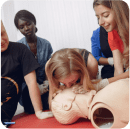
They need to be flat on their back, on something firm. The floor is ideal. Beds or soft surfaces don’t work well you won’t get enough pressure with your compressions. Kneel beside their chest so you’re stable.
Starting compressions
Hands go in the centre of the chest. One on top of the other. Arms straight. Then you press down hard and steady about a third of the chest depth and keep a consistent rhythm.
This is the part people remember from training. It’s also the part that tires you out faster than you expect.
Keeping the cycle going
You stick to that 30 compressions to 2 breaths pattern. Over and over. It’s repetitive, but that’s the point it keeps blood moving until something changes.
There’s no perfect way to handle an emergency. But there is a clear way. And when things get messy, which they usually do, having that structure in your head makes a big difference, a CPR course can be the difference between life & death. Be sure to check out our CPR Courses to be prepared.